
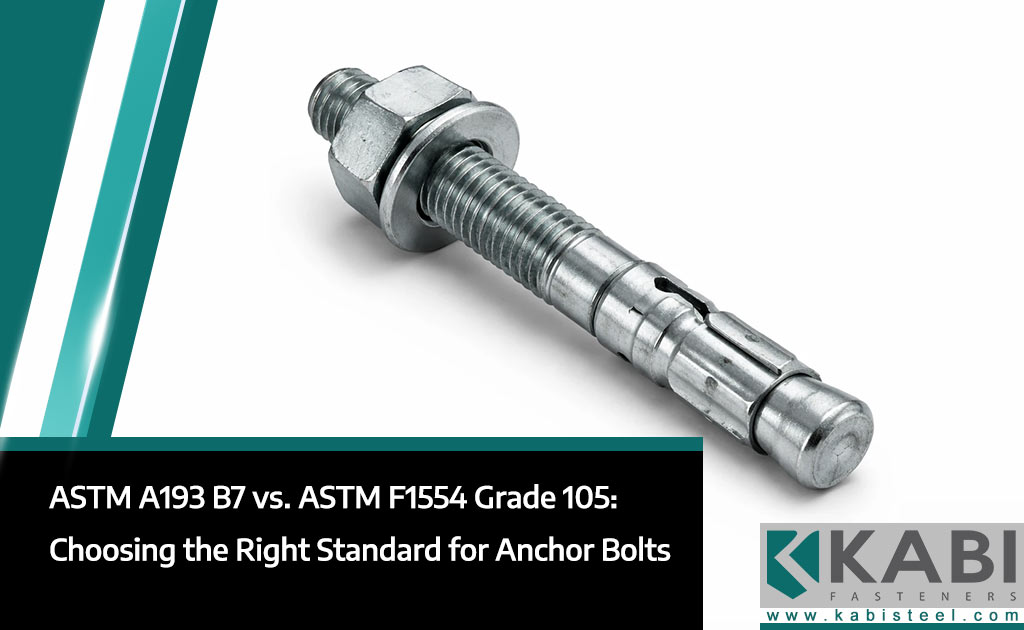
Although there is no formal restriction on using ASTM A193 Grade B7 for anchor bolt applications—and manufacturers such as Kabi Steel commonly produce anchor bolts from this material—the reality is that this specification was not originally developed for anchor bolt use. In contrast, ASTM F1554 Grade 105 is a standard specifically intended for anchor bolts, and its chemical composition and mechanical performance are, for all practical purposes, very similar to those of A193 B7.
The ASTM A193 standard defines requirements for alloy and stainless steel bolting materials used in high‑temperature or high‑pressure environments such as pressure vessels, valves, flanges, and piping components. Due to its large‑scale production and widespread availability, Grade B7 is commonly supplied in the market as both heavy hex bolts and all‑thread rods. As a result, this grade is well known among engineers, contractors, fastener distributors, and bolt manufacturers. This broad familiarity is likely one of the key reasons why A193 B7 is frequently used in anchor bolt applications, despite not being designed for that purpose.
Another important factor that makes A193 B7 less than ideal for anchor bolts is its thread pitch requirement, as governed by ASTM A962. According to this requirement, all A193 fasteners with diameters of 1 inch and larger must be manufactured with 8 threads per inch (8 TPI) unless explicitly specified otherwise.
While the phrase “unless otherwise specified” technically allows A193 anchor bolts to be produced with standard coarse threads (UNC), the default 8 TPI requirement can lead to higher manufacturing costs, supply limitations, and increased nut prices at larger diameters—particularly for galvanized nuts. In fact, for galvanized nuts with 8 TPI and diameters exceeding 1‑1/2 inches, there is no standardized or publicly documented oversize tolerance available.
For these reasons, when the intended application is anchor bolts, ASTM F1554 Grade 105 represents a more suitable alternative to A193 B7. As noted earlier, F1554 was developed specifically for anchor bolt use and closely matches A193 B7 in terms of chemical and mechanical properties. For diameters up to 2‑1/2 inches, both standards share the same minimum yield strength of 105 ksi and minimum tensile strength of 125 ksi. The difference lies in the upper limit: F1554 Grade 105 specifies a maximum tensile strength of 150 ksi, whereas ASTM A193 does not impose an upper tensile limit. In addition, F1554 places no specific restriction on thread pitch, which simplifies manufacturing, improves availability, and reduces overall costs for anchor bolt production.